Showing posts with label Statesmen. Show all posts

Tuesday, April 1, 2014

Stanley Kramer | The Larger Picture | Statesmen


When I dedicated my short film to him, it was for a reason. He changed my outlook towards the purpose of making films. I would rather make dated films than irrelevant ones. To stress a little more on this, I would share a quote by one of the greatest filmmakers of our times Steven Spielberg who said that Stanley Kramer is one of our great filmmakers, not just for the art and passion he put on screen, but for the impact he has made on the conscience of the world.
 
Stanley Kramer is known for his message films dealing with socially relevant and controversial topics like racism, anti-Semitism and social disparity. His ability to focus on topics rather than money making films and remain strong impressed critics and audience alike. Films like Not As A Stranger, The Defiant Ones, Judgment At Nuremberg, Guess Who’s Coming To Dinner, Inherit The Wind, On The Beach and Ship Of Fools are testament of his belief that films can pass a message strongly. He faced sanctions and criticism from certain sections but he remained unperturbed.
 
One noted criticism for Guess Who’s Coming To Dinner was that he created a white black character to be played by Poitier. The character was so well creased out that it appeared to be of a white man than a black. Though the critic made a good point because most of the Afro-Americans would rarely be in shoes Poitier’s character was in. However, he missed a point. Hypocrisy of prejudice against a certain race can be exposed only when the only difference remains of that single denominator. In this case – color. Kramer understood this and ensured that he was not comparing apples with bananas. To add to this, the timing of release was simply perfect.
 
Stanley Kramer’s ability to make relevant films for popular audience can be as much as textbook material as his ability to make films with limited resources and constrained budgets. He was one of the proponents of independent film culture in mainstream Hollywood. His experience as producer of low budget films was one of the main forces behind his ability to make films about controversial topics. He was able to take financial risk because he was not risking everything. It come as a help when he became director. Both Judgment At Nuremberg and Guess Who’s Coming To Dinner were shot largely in one location.
 
Stanley Kramer redefined being American. To people who criticized his films being un-American, he said – “Any American film that contains criticism of the American fabric of life is accepted, both critically and by the mass audience overseas, as being something that could never have been produced in a totalitarian state. This in itself builds tremendous respect for American society among foreigners—a respect I've always wanted to encourage.”
 
Written By: Sujoy Ghosh

Wednesday, October 16, 2013

Jabbar Patel | Statesmen

Not many people are good at making a politically sensitive film without glitter. Jabbar Patel is one of few filmmakers who have achieved this and he has done it many times. Umbartha, Simhasan and Dr Babasaheb Ambedkar are few fine examples. Apart from films, he has done some incredible work in theatre as well. His play by Vijay Tendulkar - Ghashiram Kotwal – is considered to be one of the finest in Marathi Theatre.

Born and brought up in Maharashtra, he was a pediatrician. His interest in theatre led him to establish an experimental theatre group Theatre Academy. One of his most popular and acclaimed play was Ghashiram Kotwal which was first staged in 1973. It established him as one of the big names in Marathi theatre. He followed it with Teen Paishacha Tamasha in 1974.

Theatre was not able to contain his ability to visualize spectacle. He stepped up to make films. In 1974 he made Samna. Cast boasted of reputed names like Mohan Agashe, Shreeram Lagoo and Smita Patil. He repeated them in many other films as well like Jait Re Jait, Umbartha, Simhasan etc. In 1995, he was awarded Nargis Dutt Award for Best Feature Film on National Integration for feature Mukta.

Year 1998, biggest film of his career came. Dr. Babasaheb Ambedkar based on illustrious life of Dalit leader and founder of Indian constitution. Backed by national authorities and NFDC, the film starred Malayalam superstar Mammootty who came up with performance of a lifetime. The film raised eyebrows of certain sections but protests were subdued. Film won many national awards and lifelong acclaim for Dr. Jabbar Patel.

Written By: Sujoy Ghosh

Monday, September 16, 2013

Robert Zemeckis | Art Of Imagination | Statesmen

Watching Bonnie And Clyde can actually be inspirational. Robert Zemeckis was motivated enough to think about joining a film school. His parents didn’t approved such an unorthodox idea. University of Southern California rejected him for his poor grades. Somehow, he got admission but the scene was anything but impressive. That was the beginning.  

Fascinated by strong and fascinating visuals, Robert was mentored by Spielberg. Robert’s first meeting with Spielberg is said to be a folklore of sorts. Robert bonded with Bob Gale at USC. They made a student film and won an award. This gave him enough confidence to approach Steven Spielberg and show his film ridiculing protocols. Spielberg liked what he saw. He backed him. His first few films failed. in 1984, Romancing The Stone was released. Speculations were of a failure. Film became a hit. First act thus accomplished. History was ready now.

He made milestone films like Back To The Future and Who Framed Roger Rabbit in 80s. Both not only were appreciated by audience, got nod of the critics as well. After exciting 80s, in 90s he made Forrest Gump which became a huge success and immortalized Tom Hanks as Gump. With awards and recognition, Robert became an icon of his own right. Not many directors have more than a handful of AFI nominations.

Written By: Sujoy Ghosh


Monday, July 1, 2013

Stanley Kubrick | Notions And Reasons | Statesmen

If I have to name 5 directors with immense impact on world cinema, Kubrick will be one of them. If I have to pick three of them, Kubrick will be still there. If I am forced to pick only one, I think I will pick Kubrick. One of the most misunderstood filmmakers of all time, Kubrick has established himself as the most pathbreaking filmmaker of all time. In over 100 years of cinema, nobody made such iconic gems spreading over every genre one can think of.

At the age of twelve, he learnt chess and when he was thirteen, his father gifted him a camera. These two things shaped his personality and his cinema. His passion for stills taught him deeper nuances of cinematography. Chess, on the other hand, made him patient and intellectually more receptive to ideas and visions. As a scholar he was average by any standards.

As a filmmaker, Kubrick was always a darling of cinebuffs. He toyed around with numerous subjects and made films which are considered to be milestones. Anti war films like Paths Of Glory and Dr. Strangelove, sci-fi like 2001 - A Space Odyssey and A Clockwork Orange, horror like Shining, period like Barry Lyndon and borderline erotica like Lolita and Eyes Wide Shut. Most of his films are not only landmarks, the approach to handle the subject is unique. He explored multiple layers in the story and allowed viewer to interpret them. Probably the best example is 2001 - A Space Odyssey.

Kubrick was a true visionary and his biggest achievement was his ability to carry visions of his colleagues along with his own. He allowed them to interpret their roles and was always ready to discuss them in detail. He was a perfectionist. Some of his actors complained of sore back. Some were tricked into doing things to add the shock value to the visual. Creative liberty and his intelligence was widely acknowledged by people who worked with him for almost five decades.

Kubrick influenced filmmakers like Woody Allen, Tarantino, James Cameroon, David Fincher, David Lynch, Scorsese, Ridley Scott, Tim Burton and Spielberg. Well, quite a legacy.

Wednesday, May 1, 2013

Anjaan | Gypsy From Shores Of Ganges | Statesmen

Among most popular songs of 70s and 80s, songs like ‘Muqaddar Ka Sikandar’, ‘Khaike Pan Banaraswala’ and ‘Ee Hai Bambai Nagariya’ would stake claims for ruling the popularity index to the extent of becoming an integral part of lingo for 90s. These songs and many amazing songs like these were penned by Anjaan who was born as Lalji Pandey. A true Banarasi, Anjaan’s poetry was heavily loaded with Bhojpuri accent which was his USP.
 
Anjaan started his career in 50s with Prisoner Of Golconda. His talent was noticed and he got more work. However, these were small films and most of his work didn’t get the recognition. Scene changed in mid 60s when he was noticed by O.P. Nayyar and later Kalyanji-Anandji, R.D. Burman and Ravi. His collaborations with them gave his career the much needed boost. Still, he was not there. 70s was his time.
 
In 70s the advent of Amitabh Bachchan was one of the key factor for his success. Amitabh’s off screen persona and background influenced writers to write more rustic characters. His strong connect with Hindi belt improvised the language of cinema. Among many films, Khoon Pasina, Don, Muqaddar Ka Sikandar and Lawaaris were the highlights. In 80s, Anjaan was one of the most sought after lyricists. In this span of almost two decades, he worked with all big names including Laxmikant-Pyarelal and Bappi Lahiri.
 
In 90s, he was not as healthy as before. With falling health, his works reduced. His son Sameer took over and became one of the leading lyricists of 90s. In year ‘97, he left this world forever. His last work released by Amitabh Bachchan, his only book of poems was a poetic summation of his life. It was titled - Ganga Tat Ka Banjara.  
 
Written By: Sujoy Ghosh


Saturday, December 1, 2012

Ricardo Darin | La Voz De Los Ojos | Statesmen

Many actors have their roots in TV Soaps. Few make impact on big screen as well. Few are recognized internationally and only a handful among them are respected as much as Ricardo Darin. Born in Buenos Aires, Argentina, Darin’s first rendezvous with acting happened when he participated in a play at age of 10. His parents were respected actors of their time. He started off with TV soaps and became a house hold name with series like Alta Comedia and Estación Retiro. Apart from TV shows, he was a regular at theatre that helped him evolve as an actor.
 
His first critical acclaim on big screen came with Perdido Por Perdido made by Alberto Lecchi. A thriller, movie was about a person who is one the verge of bankruptcy. He plans a fake car robbery which goes wrong. The situation puts him between mobsters and investigators. Darin’s versatility as an actor was recognized widely. This movie acted as his launch pad to world cinema. His movies in late 90s and early 00s established him as one of the biggest actors in Latin America. Nine Queens, El Hijo de la Novia, Luna de Avellaneda, El Aura were notable ones. El Hijo de la Novia is more known to cinebuffs as  Son of the Bride. In 2009, El Secreto de Sus Ojos (most of us know it as The Secret in Their Eyes) was released. This movie stamped his stardom and acting capabilities. A big success on BO, it grabbed many awards across the globe. The list included Oscar for Best Foreign Language Film.
 
Darin is known for his ability to infuse a sense of calmness in the scene with his screen presence. His voice and expressive eyes are considered to be his strengths. In many ways, he is similar to Mammootty as an actor. I guess that speaks volume about him.
 
Written By: Sujoy Ghosh
 

Friday, November 16, 2012

Passion Narrative - Story Of Guru Dutt - 3 | Statesmen

Waheeda Rehman was discovered in Telugu film industry. When Guru Dutt found her, she was raw as an actor. Over time she matured and gave memorable performances. Her platonic relationship with Guru Dutt was fodder for gossip magazines. He had a soft corner for her and she had emotions for him. But was that an affair, no one really knows.
 
As marriage was on rocks, Guru Dutt was slowly killing himself. He was either thinking about films or drinking. Suicidal tendencies surfaced.
 
Two movies – Kaagaz Ke Phool and Pyaasa defined his life and cinematic brilliance.
 
Pyaasa was reflection of his angst against hypocrisy in society. How people misbehave with the no-ones and run behind the names? How people don’t even hesitate in exploiting people in inferior position? How even the blood betrays? Pyaasa was story of a poet who is cheated by not only strangers but also by the people he had faith in. When his brilliance is admired by masses, they suddenly start celebrate his art. What should he do? Jump in and enjoy the empty stardom? He would rather renounce the world. Guru Dutt suffered this dilemma. Owing to responsibilities, he chose the middle path trying to balance between what he wanted and what people expected. How he wished to make more movies like Kaagaz Ke Phool which got it due years after his death.
 
Kaagaz Ke Phool was a glimpse in his life and life of his mentor Gyan Mukherjee. A successful man who fades away in the winds of changing times. Suresh is successful but unhappy because he doesn’t have a free hand in his work. His marriage is on rocks and is trying very hard to sort issues with his arrogant wife. He discovers an artist accidently and they fall in love. However, she walks away when his daughter objects. In the end Suresh doesn’t get anything except an unknown death. There was so much in common with his own life. Sort of a mirror image. Sort of a fore warning.
 
When Vasanth come he brings in gifts of nature and the bounty is cherished by all. When he leaves, he leaves silently. His absence is noticed much later. How prophetic was his name...
 
Written By: Sujoy Ghosh


Thursday, November 1, 2012

Passion Narrative - Story Of Guru Dutt - 2 | Statesmen

Guru Dutt mentored Abrar Alvi and V. K. Murthy. Former wrote some of the most memorable scripts while later raised the bar of cinematography by yards. 
 
Guru Dutt helped Abrar develop skills for direction. Abrar went on to make Sahib Bibi Aur Ghulam with Guru Dutt and Murthy. Their methodology was so similar that people believe that it was ghost-directed by Guru Dutt, a thought rubbished by people involved. However, its noteworthy that it took a Guru Dutt to bring out a director from the writer Abrar Alvi was. Sahib Bibi Aur Ghulam turned out to be his only directorial venture.
 
V. K. Murthy knew how to stretch the envelop. Brilliant use to contrast shades in black and white, especially in Kaagaz Ke Phool, caught the imagination of filmmakers across the globe. However, just like Abrar, he failed to stand at par with his own standards. Guru Dutt influence was there. With him, the light was gone. 
 
Another name which cannot be separated from Guru Dutt was Johnny Walker. Born as Badruddin Jamaluddin Kazi – Johnny Walker, along with Rehman, was one of the most common faces appearing in Guru Dutt’s cinema. He provided Guru Dutt’s intense cinema with the light moments it needed. Their bonding was so strong that absence of a role in Sahib Bibi Aur Ghulam was Johnny Walker was opposed by Guru Dutt. Abrar remained adamant and Guru Dutt gave in once Johnny Walker gave his best wishes.
 
Like many iconic filmmakers, Guru Dutt was not able to separate his personal and professional life. Had he taken the path followed by Raj Kapoor, we would have seen more of him. Guru Dutt fell in love with Geeta Dutt, a singer of great repute. She was very successful as an individual and as a result, clashes happened. Alcohol didn’t helped either. Both took to hard drinks and slowly ruined their life. People believe that Geeta Dutt was always very suspicious of Guru Dutt’s personal life outside home. Rumors of his affairs compounded more problems. And there was a Waheeda…
 
Written By: Sujoy Ghosh


Tuesday, October 16, 2012

Shankar Nag | The Karnataka Films Icon | Statesmen

South India cinema consists of 4 prominent languages namely Kannada, Malayalam, Telugu and Tamil. But when it comes to ranking Kannada cinema industry is usually perceived to be inferior. Albeit, few people would look into Kannada cinemas whenever, there are releases of few directors like Yogaraj Bhat, Soori, Upendra, R.Chandru, Shashank, Preetham Gubbi, Prem(Besagara Halli Bairegowda), Om Sai Prakash, Om Prakash Rao, GuruPrasad etc. or few stars like Puneeth Raj Kumar, Shivaraj Kumar, Sudeep, Darshan, Ganesh, Ajay Rao, Diganth, Upendra, the most of the films would go un-noticed. But there was a man who had single handedly made whole India forward to Kannada Cinema for short span of 12 years with his 90+ films. This man was none another than Shankar Nag.
 
Shankar Nag was born on November 9, 1954 in Mallapur Village, Kumta (North Canara), Karnataka as younger brother of versatile multilingual actor and former minister of Government of Karnataka, Ananth Nag.  Albeit, he completed schooling at Bombay and was involved in Marathi theatre his cinema debut was with Girish Karanad’s Kannada film Ondanondu Kaladalli which was an Off-beat Kannada which was also a commercial success. After that,  within the span of 12 years (from 1978 to 1990) he acted in some 80 Kannada movies, in leading role, besides co-producing (with actor-brother Anant Nag ) and directing 12 films like Minchina Ota,  Accident, Ondu Muttina Kathe, Nodi Swami Naavirodu Heege, Hosa Teerpu, Lalach, Janma Janmada Anubandha and Geetha. Although, some of the movies were not critical success, it is believed that none of his movies lost business. He also directed tele serial Malgudi Days based on R.K.Narayan's short stories. Besides these, he was actively involved in Kannada Theatre. He also co-wrote 22 June 1897, an Indian National award winning Marathi film.
 
His films like Accident, Minchina Ota were not big commercial success, but it had won many National and international awards. Apart from these movies there is one movie which has made him remain in hearts of Kannadigas. That movie is none other than Auto Raja. This movie has made people remember him, 22 years even after his death. We can still see Autos in Karnataka which has Shankar Nag’s photo.  Auto drivers still consider him as the role model in Karnataka. Interestingly, he died in a car accident.
 
Not only liberal arts, he will be remembered also for modernization of Karnataka. He was instrumental in realization of Banglore Metro and establishment of Karnataka Milk Federation with brand Nandini. So much for a man who lived for just 35 odd years.
 
Written By: Sandeep Shetty

Passion Narrative - Story Of Guru Dutt - 1 | Statesmen

What an irony? A person born as Vasanth became famous for ‘Kaagaz Ke Phool’ and ‘Pyaasa’. 
 
Guru Dutt...
 
10 October 1964. News spread like fire in dry wild. Guru Dutt died an untimely death. Some speculated accidental overdose of sleeping pills and some saw it as a suicide bid. But the bottom line was that one of the biggest contemporary name became a page of past. A tragedy to be mourned over again and again. As obituaries started flowing in, people realized that despite of all success and all acclaim, there was a big void in life of Guru Dutt – lack of personal harmony. What they saw in his characters in Pyaasa and Kaagaz Ke Phool... had much more than a hint of reality. Much more.
 
Born in Bangalore, Guru Dutt had more than his share of sorrows. Financial constraints and tension between parents affected him. But it was his kid brother’s death inflicted more injury than anything else.
 
His early days in Calcutta shaped him as an artist. Like any other artist, he struggled hard. He started with Uday Shankar’s troupe. This helped him later when he worked as a choreographer. His stint with Uday Shankar taught him the importance of discipline and enhanced his artistic vision. Guru Dutt began his career as an Assistant Director and Choreographer. His experiences with Gyan Mukherjee as his assistant helped him understand the nuances of cine-world in and outside the film studios. In his early days, Guru Dutt bonded well with Dev Anand and Rehman. His friendship with two established faces made his way easier. Dev Anand offered him his first film as director – Baazi. Baazi established Guru Dutt as a promising director. A journey thus started...
 
There are reasons to believe that many times Guru Dutt was held hostage by industry norms and producer’s whims. Sometimes he would abandon the project and sometimes he would just give in. After Baazi, Jaal and Baaz came. Both failed. However, these two movies helped him develop the famous Guru Dutt Team. Over the years, this team influenced Indian cinema to a great extent.
 
Written By: Sujoy Ghosh
 

Sunday, July 1, 2012

Brand Ram Gopal Verma | Statesmen

Ram Gopal Verma, this name today invites groans and anxiety from viewers across India. About 7-8 years ago, it was the other way round. Mention of RGV (as Ram  Gopal Verma is fondly referred to) triggered anticipation in most film buffs. Most of his earlier films were critically acclaimed and moderately to highly successful.

He entered public imagination with his hit Rangeela. It was different from formulaic films love stories being made at the time. It had characters that were different than the stock movie characters of that time. It had a story of a superstar, a starlet and a roadside romeo.

This followed with the crime drama Satya. Like Hum Aapke Hain Kaun, which started trend of big family films, Satya started a trend of realistic gangster movies. In this series of movies came Company, which was near perfect in all respects and is infact one of my all time favourite movies.

Then Verma turned attention towards Horror films. He made classic Bhoot and continued making more horror film. This point on it was big spiral downwards in terms of quality. Critics and audiences started disliking RGV’s films. This triggered what seems like an adamant streak in Varma in which he stopped caring for what others had to say. He has famously said,’I make movies for myself’.

RGV ki Aag became his biggest undoing. Lately he has been dabbling in experiments.Department recently was shot with non-professional cameras. As Anurag Kashyap recently said about RGV that  he is like child with toys. He has lost direction, doing experiments with other people’s money. If he doesn’t make a decent movie soon, people might start asking same question as they did for Dev Anand, ‘Who pays for him to making movies?’

Written By Ali Naqvi.

Brand Anurag Kashyap | Statesmen

When we collected votes for first Uttkrishtt, I was a little surprised. Black Friday was rated higher than Mother India, Pyaasa and Sholay. It was #2 on our top Hindi film list. That was a small indication how strongly Brand Anurag Kashyap has evolved over the years. From being the face of independent cinema in this country, today Anurag is perhaps the most respected Indian director. How strong is this brand can be easily gauged by the fact that many people went to see Shanghai because Anurag strongly recommended it (by my personal experience). The reco was all over the papers and people were booking their tickets online.

In intial days, when Anurag was still a student at Hansraj College, Delhi University, he developed an interest in world movies. In a film festival he happened to see Bicycle Thieves and had his Satyajit Ray moment. The impact of de Sica revered neo-realistic film was huge. Like Ray, Anurag decided to take his steps forward in the world of cinema and landed in Mumbai. He joined theatre, tried acting and writing and joined a group of likeminded people. After lot of hardships, he got his big break with Satya. Satya and established him as a script writer. But still a lot was amiss. He was a name in inner circles of industry. Satya was a RGV movie for public. AK was just an unknown entity.
 
Anurag took a step forward and directed Paanch and Black Friday. Paanch was written during his early days in Mumbai when he was a nobody and elements of frustration of a young nobody were visible. Black Friday was a clinical study of Bombay Bomb Blasts. Paanch never saw the daylight however is perhaps one of the most acclaimed work. Black Friday fought court cases and was released. These two movie hardly gave Anurag a financial boost but the acclaim these movies got made a thumping noise. Anurag arrived the scene.

Paanch was banned. Black Friday saw monstrous roadblocks. Still the name evolved. No Smoking came and masses rejected it. People started doubting. Then came Dev D and the duo of Abhay Deol and AK nailed it. The adaptation of Devdas got adulation at Box Office. His repute as a strong storyteller was an established fact. He backed Aamir, Shaitan and Udaan. Each of them changed the outlook of Indian film audience. Despite of his failures on BO for Gulaal and TGIYB, Brand Anurag Kashyap has evolved largely due to multiplex culture and exposure to world cinema due to torrents. Lack of many intelligent makers beyond studio and camps helped his cause and made him the poster boy of Indian Indie.

Written By: Sujoy Ghosh

Friday, June 1, 2012

James Stewart | The War Veteran And The Movie Star | Statesmen

James Stewart career saw a high when he was chosen by Frank Capra for  You Can't Take It With You. Capra had a successful record as a film maker and struggling Stewart couldn’t have asked for any more. In 1940, his success saw a new high with The Philadelphia Story. He earned an Oscar. In 1941, he was serving Army Air Corps. In World War – 2, he was perhaps the first highly billed movie actor to wear the uniform and serve the nation.

His success as an actor was perhaps the biggest hurdle. Serving nation in wars was a part of James Stewart’s lineage. His grandfathers from maternal and paternal side fought in Civil War. His father was a veteran of Spanish-American War and WWI. Despite of being underweight, he somehow managed to gain muscles just in time and get enlisted for Army Air Corps. However, due to his celebrity status, it was highly likely that he would not be sent for combat. Tides favored this assertion. However, he convinced his commanding officers and was sent in combat. He went and did exceptional.

James Stewart rose to the rank of Brigadier General. President Reagan appreciated his services and promoted him to Major General. As an actor, he never boasted of his achievements as a war veteran. A true patriot, James maintained the sanctity of the medal he won. For few years after war, his accomplishments as an actor were rather mediocre. Only notable movie was It’s a Wonderful Life which got mixed reviews, did average on box office but received acclaim over years as a classic. In 1950s, his career revived to some good extent with a few westerns he acted in. Winchester '73 released in 1950 did good business. It was a big turning point in his career. So, was his collaboration with Hitchcock.

His first movie with Hitchcock was Rope. However it was the second movie which caught imagination- Rear Window. His further collaborations were The Man Who Knew Too Much and Vertigo. Vertigo didn’t fared well and got negative reviews. It marked the end of a great partnership on a sour note. In later years, he did many successful movies including The Man Who Shot Liberty Valance, Mr. Hobbs Takes a Vacation and highly acclaimed  Anatomy of a Murder. After a wonderful life, he left this world in 1997. He was 89.

Written By: Sujoy Ghosh


Friday, December 16, 2011

Dev | Romancing With Life, Literally | The Statesmen

Cinema in every era has an actor who is labeled as ultimate romantic hero. However, rarely we have a hero so convinced with the idea of romance that even after seeing 88 candles on cake; he is ready to dance around trees. Dev Anand was such an hero. No wonder he titled his autobiography as ‘Romancing with Life’. This December, we lost him… forever. But let me remind you, the romance is still there and will remain there. People die, their cinema keeps them alive.

In 1948 when Ziddi came, Dev Anand had a name though not a big one. He had a few hit movies with Suraiya but since Suraiya was a bigger star, she received all the accolades. His relationship with her was in shambles. Ziddi was the breakthrough he desperately wanted and fortunately got. Baazi, Taxi Driver and Nau Do Gyarah established him as a star. He charmed his fans with his style in movies like House No. 44, Pocket Maar, Munimji, Funtoosh, C.I.D. and Paying Guest. His style and stardom established him as a part of famous Dev-Dileep-Raj trio. These three icon ruled the cinema of 50s and 60s.

Guide gave him the character of life time. He realized the power of a woman’s sexuality and its social acceptance. ‘70s arrived and he was still a hero. He romanced with Zeenat Aman, Rakhee and Hema Malini to earn the title of Evergreen Hero. No one pulled off the stereotyped character of Romantic Hero like him. Even his ventures in ‘90 and ‘00s when his movies failed to impress audience, one can see the youthfulness in his vision.

People labeled him a crackpot when his movies failed in last two decades. Some people can’t understand what Dev Anand actually was. In his life, he reached the point where it was difficult to differentiate between cinema and life. I sense the hypocrisy when people snub his movie ‘Censor’ that spoke about liberation but go out and watch movies with skin show. The good thing was that Dev Sa’ab was convinced about his ideology and hardly gave a dime to what detractors thought. He worked till his last breath. Up there, I guess, apsaras must be pretty busy right now.

Written By: Sujoy Ghosh

Sunday, October 16, 2011

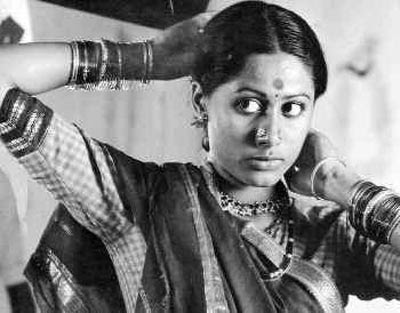
Smita Patil | The Real Talent | Statesmen

Ardha Satya, Shakti, Mandi, Manthan, Bhumika, Aakrosh, Bazaar, Chakra, Chidambaram and Mirch Masala... Most of the actresses in current crop would be proud of herself if she gets even 1 second presence in any of these movies, Smita Patil did all of them... mostly as lead and heavy duty roles. Her filmography boasts of movies like these and a few other acclaimed ones, experience of working with actors like Naseeruddin Shah, Om Puri, Amitabh Bachchan, Raj Babbar and Girish Karnad and  directors like Shyam Benegal, Govind Nihalani, Mrinal Sen and B.R. Chopra. Uff... quite a list.


Smita was known as an intense actress. She had the power to hold a scene with great Ʃlan. Something Meena Kumari was capable of doing in a more romantic way. Smita carved her niche in a male dominated cinema and portrayed many strong female characters like Sonbai in Mirch Masala. Even in smaller roles, like the one in Shakti, she used to put in so much energy. She was not exactly a fit for commercial cinema but still made a mark in commercial hits like Shakti and Namak Halaal in which she was paired opposite to Amitabh Bachchan.


Her dedication for parallel cinema has no parallel. She was face of parallel cinema in 70s. She was a favorite of directors who spearheaded the parallel cinema movement. However, at a point, she was 'unceremoniously' removed from projects just to accommodate more commercial faces to make movies more commercially viable. What a shame it was? At that time, Smita decided to move to commercial cinema. Though the decision didn't work out much in her favor, she earned respect of likes of Ramesh Sippy and B.R. Chopra. Talent can earn respect anywhere, she proved.


Written By: Sujoy Ghosh

Thursday, September 1, 2011

Rekha | The Eternal Diva | The Statesmen

Rekha and glamour are like synonyms in the Indian film industry. At fifty plus, she can still hold you spellbound. Poise, beauty and even talent can be acquired. But glamour is something a woman is born with. And Rekha is born with it.

Apart from glamour, gossips are something that has always gone hand in hand with Rekha. Be it about her illegitimate father or her romance with AB, or sudden suicidal death of her husband, or co-actresses comments on her skills /behavior. I have no answers for these questions, and though many may say that these rumors have been a major part in the publicity and her success, but as her fan, I believe, she is a volcanic actress and yet unmatchable in Bollywood. The camera seems to be virtually in love with her face and her well known trademarks, the seductive tone and mesmerizing eyes.

Over the forty odd years of her career, she managed to reverse the trajectory of the Bollywood dream girls. She has gone from being a starlet to being an actress to being a model. She has been particularly recognized for playing female-oriented characters. Her portrayal of a simple school-girl in Khubsoorat and a classical courtesan in Umrao Jaan are examples of her versatility. No one can carry off the 'period' look replete with elaborate costumes and regal bearing as well as her. And all those other actresses who have often commented or shrugged off all ambition to be Rekha know they can never be like her.

She has reinvented herself numerous times in her career and is known for her ability to sustain her status. Even when Mahrashtra govt. announced, Raj Kapoor Jeevan Gaurav Award" (Lifetime Achievement) to Rekha, she refused to accept it, as it went against her own concept of work and self-image. Moreover when her co-stars had started taking up motherly roles, she came up with unconventional roles in movies like ‘Lajja’, ‘Khiladiyon KaKhiladi’ and ‘Zubeida’. And incidentally, all these films were quite successful, prov­ing the fact that the audience still expects Rekha to come up with something sensational.

Apart being the diva and the glamour queen, Rekha has always been known for her mystique personality too. But she has never allowed her mystique to be used to sell other men’s products. As an ordinary movie buff, I have read stories in magazines about her generous acts to co-actresses and accommodating attitude to return friendly gestures, then I really feel sad to know that now she lives all by herself in her ivory tower, leading a reclusive life. Yet her fans will never decrease and she’ll remain the greatest and most beautiful actress of all times.

Written By: Neha Jain

Friday, July 1, 2011

Hrishikesh Mukherjee | Cinema of Life | Statesmen

Very few people have championed the art of realistic cinema the way Hrishi Da did. When today we envision a realistic movie, we see dark movies with feel of gloom, pain and sometimes even gore. Real world is not always gloomy. Real people try to handle things in very simple ways. Hypocrisy is not so common as shown by some of the directors today. Circumstances are not always so bad. It has become quite a trend to rip off an non-hindi movie, put the protagonist in slums and add some double meaning sleaze, and pass it off as realistic cinema.


Hrishi Da interpretation of people and their sensibilities can be attributed to his humble upbringing in Calcutta (now Kolkata). He also worked as a teacher for some time. His middle class life and experiences as a teacher reflects in his work. His education of cinema got the patronage of B.N. Sircar, Subodh Mitter and Bimal Roy. Bimal Roy had a strong influence on his though process and cinematic works. He was a part of crew of Do Bigha Zameen and Devdas. Under mentorship of Roy, Hrishi Da started his career ad director with movie Musafir. It was not a success. However his second movie Anari gathered lots of acclaim and attention.


People appreciated the sensitive treatment of his stories woven around simple characters and ordinary circumstances. Be it emotional attachment of doctor and patient (Anand), relationship between Industrialist and employee friends (Namak Haraam), falling relationship between successful wife and no-longer-successful husband (Abhimaan) or a man trying hard to remain honest in a corrupt world (Satyakam), he presented each of them in a very honest way. Subtle spurts of comedy was his specialty. Those little doses were very prominent in even his serious works and were actually his USP to some extent.


Among the people born in 80s and 90s, his comedy movies were more popular than those with a serious vein. Gol Maal, Naram Garam, Bawarchi, Kisi Se Na Kehna, Chupke Chupke etc. are still loved by masses. These movie had a simple plot with a small innocent deceit as a ploy. The circumstances would lead to situations where natural reactions would evoke comedy. Noted director Basu Chatterjee also adopted this style very well.


Hrishi Da is remembered as one of the most respected movie maker of Indian cinema and his contribution will keep on bringing smiles on the face of his viewers


Written By: Sujoy Ghosh

Thursday, June 16, 2011

Jean Renoir | Early Life | Statesmen

Revered as one of the icons of French Cinema, Jean Renoir was a visionary ahead of his time. Movies like Les Bas-Fonds, La Grande Illusion, The River The Diary of a Chambermaid, The Southerner etc. engraved his name in history of world cinema with golden letters at par with likes of Akira Kurosawa and Satyajit Ray. Infact, while Renoir was in India for the shooting of The River, he interacted with Ray and later Ray confessed that Renoir had some great effect on him as a filmmaker.


Born in Montmartre, France, Jean Renoir was son of Aline Charigot and noted French painter Pierre-Auguste Renoir. His father achieved both critical acclaim and financial security as a painter. Jean got good schooling in boarding schools. Though it shaped him as a person, he hated them. Due to environment at home, he inherited a sense of art and literature which became his forte in later years.

As young man, he joined armed forces during World War 1. He got injured when a bullet found its way to his leg. It left him partially handicapped for rest of his life. However, this turned out to be the turning point for him. He watched a lot of movies and found a passion for it. Though after War he tried his hand on ceramics but later gave it up to pursue the motion cinema. The journey thus began…

Written By: Sujoy Ghosh

Wednesday, June 1, 2011

Shailendra- Lyricist | Statesmen

“Chhoti si yeh duniya pehchaane raaste hain,    Kahin to miloge phir poochhenge haal”

This couplet woke up Shankar Jaikishan from their sleep and reminded them about the promise they made to a budding lyricist. The depth in the sarcasm pricked them hard and the raw emotion laid the foundation of one of the most memorable musician-lyricist team with Shailendra being the latter.

Songs like Ramaiya Vastavaiya, Piya Tose Naina Laage Re, Kisi Ki Muskurahaton Pe Ho Nisaar, Dost Dost Na Raha etc. are still hot favorites among those who love Antakshari and smile at the thought of Aakashvani. These memorable songs were written by Shailendra whose pairing with Shankar Jaikishan and Raj Kapoor shelved out many memorable hit numbers in ‘50s and ‘60s.

A communist at heart, Shailendra initially turned down Raj Kapoor’s lucrative offer to write poems for his film because IPTA opposed Mainstream cinema those days. However, later due to financial crisis he wrote a few songs for Kapoor. Kapoor was generous and thus, they became great friends. Kapoor himself believed in socialism. Iconic song ‘Mera Joota Hai Japani’ was a sincere tribute to communism of Russia and its socialist adaptation by Congress in India. The protagonist keeps imperialist & industrialist Japan under his feet. He doesn’t pay much respect to English by keeping them under belt (‘Patloon Englishtani’). However salutes Russia (‘Sar Pe Laal Topi Roosi’) and is proud of being an Indian (‘Phir Bhi Dil Hai Hindustani’).

Shailendra invested on a movie- Teesri Kasam based on Renu’s ‘Uff Maare Gaye Gulphaam’. The movie is considered to be a classic however it proved to be a poison-coated diamond for him. Shailendra was a poet and had no bone to be a producer. But he wanted to do it. Raj Kapoor and Waheeda Rehman were roped in. Basu Bhattacharya, the director, was a short tempered person. One day, he left the project like that. It was editing phase. Raj Kapoor himself volunteered and completed the editing. Movie was beyond time, over budget and Shailendra was under hefty debts. To help him out, Raj Kapoor waived off his bill and asked for only one rupee. But by then damage was already done.

1966, Teesri Kasam saw its release. 1966, Shailendra left… forever.

Written By: Sujoy Ghosh

Monday, May 16, 2011

Khwaja Ahmad Abbas | Statesmen

K.A. Abbas is well known name for many reasons. A novelist, a screen writer, a film maker and columnist of the longest running column- Last Page. One of the most accomplished work of cinema crafted by him was the movie ‘Saat Hindustani’ which saw advent of a lanky young man who rewrote the history of cinema and influenced the entire country for next 40 years… Amitabh Bachchan.

Born in a family proud of being the bloodline of Aiyub Ansari who was a companion of Prophet Muhammad, martyr of 1857 rebellion Khwaja Gulam Abbas and poet Khwaja Altaf Husain Hali who was a student of Mirza Ghalib, K. A. Abbas made a niche for himself. Literature was his natural forte. In about 75 books he wrote, Abbas reflected his socialist and open outlook. His most celebrated work Inquilab is considered to be one of the best pieces of literature in Urdu. It reflected the trauma and pathos of common man in struggle of independence.

His directorial debut was Dharti Ke Laal. With iconic Balraj Sahni, this movie was made for IPTA. The movie dealt with Famine in Bengal of 1943. Around this time only, he wrote Neecha Nagar and Dr. Kotnis Ki Amar Kahani for Chetan Anand and V. Shantaram. Former won Golden Palm at Cannes and till date is the only movie with the honor. He also collaborated as writer with Raj Kapoor in thought-provoking movies like Awara, Shree 420, Jaagte Raho and also in likes of Mera Naam Joker, Bobby, Heena. Two other highly rated movies he made were Saat Hindustani and Do Boond Paani. Both were awarded Nargis Dutt Award for Best Feature Film on National Integration. Not many people in cinema can boast of such acclaimed profile.

K.A. Abbas’ strength was his sensibility and wide spectrum of knowledge. He had an instinctive sense of film-making and knew how to make a statement with a dialogue or scene. His works were thought-provoking and revealed the reality in a poetic way. If you want to see his genius, watch the last scene of Saat Hindustani where all men come together…

Written By: Sujoy Ghosh